Search This Blog

Tuesday, January 31, 2012

Know Your Wood: Curupay

Curupay
Dark and distinctive, Curupay, or Cebil, is a great choice for a great many applications.

Common trade names: Cebil, Curupay

Genus: Anadenanthera colubrina (syn. Anadenanthera macrocarpa)

Janka Hardness (pounds-force): 3630

Description: Curupay features deep brown to brown-red hues, characterized by prominent streaking, regularly following the grain patterns of the wood. The grain is highly interlocked and moderately figured, and Curupay has a fine to moderate texture.

Location: Latin America, specifically: Argentina, Brazil, Paraguay, Peru, Bolivia

Common Aliases: Angico, Cambui-ferro, Cebil moro, Curupay-ata, Guarapiraca

Performance: Almost as hard as any wood available, this is a fine choice for exterior application. It is highly insect and rot resistant, and is a more or less generational solution for the designer or homeowner. It’s very distinctive, and if architects or designers are searching for a wood that will “pop,” this is one species that can do the job, and can stand the test of time.

Acclimation: Please, always properly store and set aside your lumber! We can’t stress enough the importance of just a little patience when receiving your order. For air drying, simply allow a half-inch or so among parallel planks stacked and spaced by level. It’s that easy, and in two or so weeks’ time, the lumber is ready for installation in your climate!

A Curupay tree, found commonly in South America.

Common Uses: Tool handles, docks, chemical containers, foundation pilings, furniture, ground contact, vehicle parts, wharf building, exterior and interior trim, rain screen siding, shiplap, turnings.

From: The Wood Database

Common Name(s): Cebil, Curupay
Scientific Name: Anadenanthera colubrina (syn. Anadenanthera macrocarpa)
Distribution: Argentina, Brazil, and Paraguay
Tree Size: 65-80 ft (20-25 m) tall, 2-3 ft (.6-1.0 m) trunk diameter
Average Dried Weight: 66 lbs/ft3 (1,060 kg/m3)
Basic Specific Gravity: .86
Hardness: 3,630 lbf (16,150 N)
Rupture Strength: 28,010 lbf/in2 (193,180 kPa)
Elastic Strength: 2,639,000 lbf/in2 (18,200 MPa)
Crushing Strength: 14,100 lbf/in2 (97.2 MPa)
Shrinkage: Radial: 4.6%, Tangential: 7.6%, Volumetric: 12.0%, T/R Ratio: 1.7

Know Your Wood: Australian Buloke

Australian Buloke

The Australian Bull Oak tests out as the most difficult to penetrate by at least one measure.

Common trade names: buloke, bull-oak

Genus: Allocasuarina luehmannii

Janka Hardness (pounds-force): 5060

Description: Possibly there exist limitations to what a woodworker will endure. I’ve been unable to locate any information about the use of this lumber as a lumber, but I’ve found that it’s vital to the continuing survival of a southeastern subspecies of the Austrialian Red-tailed Black Cockatoo for both food and lodging.

Location: Victoria, Queensland, New South Wales in Australia

Common Aliases: Australian buloke, Australian bull-oak

Performance: If you can get your hands on some of this, please let me know how it turns out for you. I believe it would be interesting to hear at least one opinion except that it’s the hardest wood that’s been tested with the Janka scale. There is mention from Australian government issues alluding to its strong performance as a fuel wood. It looks like it should be able to grow about anywhere, and it is unclear whether this wood is useful at all to the professional or hobbyist woodman.

Acclimation: It looks as though one would have to travel to Australia, and possibly purchase this wood on the black market. I have seen no place where it is being sold in the United States, and I don’t know how Australian jails might differ from American ones, should its trade be illegal. Again, your input could be helpful in this identification project.

Common Uses: Nesting and feeding of the Australian Red-tailed Black Cockatoo.

From: florabank

Common Name(s): Allocasuarina luehmanni
Scientific Name: Allocasuarina luehmanni
Distribution: Queensland, Western New South Wales, Northwestern Victoria
Tree Size: 30-60 ft (10-20 m) tall, 2-3 ft (.6-.9 m) trunk diameter
Average Dried Weight: N/A
Basic Specific Gravity: N/A
Hardness: 5,060 lbs.f.
Rupture Strength: N/A
Elastic Strength: N/A
Crushing Strength: N/A
Shrinkage: N/A

Know Your Wood: Lignum Vitae

Lignum Vitae
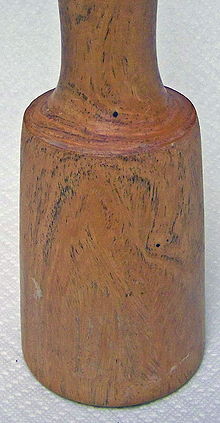
Try not go get whacked with this bad boy. It will win the mallet v. bone competition.

Common trade names: Bera, guayacan, guaiacum, pockenholz (European),

Genus: Guaiacum officinale

Janka Hardness (pounds-force): 4500

Description: Deep olive-brown to brown, sometimes approaching black. Has a uniquely layered grain pattern when held under close inspection. There are trade substitutes available to genuine Lignum Vitae, but the Argentine Lignum Vitae (Verawood) is generally lighter color than that of the wood specified herein.

Location: Caribbean and Central and South America, namely: Bahamas, Costa Rica, Cuba, Hispanola, Nicaragua, Guatemala, Venezuela, Puerto Rico. Farming operations are underway worldwide to ensure continued production of this valued species, though it is currently a highly endangered species.

Common Aliases: Bois de gayac, Bois sant, Legno benedetto, Legno nefritico, Legno santo, Wood of life

Performance: Please take very light passes when working Lignum Vitae. It’s about as hard and as durable as can be obtained against the plagues of rot and insect.

Acclimation: If you’re purchasing Lignum Vitae, you already know this, but for air drying, simply allow a half-inch or so among parallel planks stacked and spaced by level. It’s that easy, and in two or so weeks’ time, the lumber is ready for working in your climate!

Common Uses: Tools, bearings and bushings, pulleys, turnings, countless other turnings and various works requiring the most durable of woods.

From: The Wood Database

Common Name(s): Lignum Vitae
Scientific Name: Guaiacum officinale, G. sanctum
Distribution: Central America and northern South America
Tree Size: 20-30 ft (6-10 m) tall, 1-2 ft (.3-.6 m) trunk diameter
Average Dried Weight: 84 lbs/ft3 (1,350 kg/m3)
Basic Specific Gravity: 1.02
Hardness: 4,500 lbf (20,020 N)
Rupture Strength: 17,760 lbf/in2 (122,490 kPa)
Elastic Strength: 2,304,000 lbf/in2 (15,890 MPa)
Crushing Strength: 11,400 lbf/in2 (78.6 MPa)
Shrinkage: Radial: 5.0%, Tangential: 8.0%, Volumetric: 13.0%, T/R Ratio: 1.6