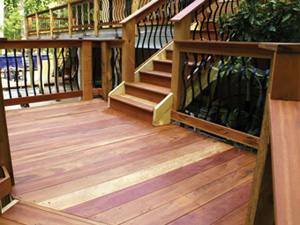
Ipe
A nice reminder of our 2011 website...
Common trade names: Brazilian Walnut and Ipe refer to several species of the Genus Tabebuia.
Genus: Tabebuia spp.
Janka Hardness (pounds-force): 3680
Description: Ipe is the hardest easily available tropical hardwood we offer. Its hues are generally an olive-brown, and the density of the lumber is quite impressive. Be prepared, as the grain pattern can be all over the place with this species. It’s as hard and durable as anything you’ll find.
Location: Central and South America
Common Aliases: Ironwood©, Pau d’Arco, Yellow Poui, Betharbara
Performance: It’s oily, it’s hard to glue, it’s hard to cut, and it will break every bit in your set. That said, once installed it’s awfully hard to beat. Many designers, builders, and homeowners regard this as an investment grade wood due to its ability to resist decay by weather or pest. Do not use compressed air tools without wearing goggles, gloves, thick clothing, in an otherwise empty room, as the fasteners will be airborne and elsewhere once you attempt to nail this material. Pre-drill, then screw, and it holds remarkably well. Hidden fastening systems were made for lumbers such as Ipe and Cumaru. Use air dried Ipe for outdoor projects, kiln dried for your indoor flooring and cabinetry applications.
Acclimation: Ipe for an outdoor application should be kept on site, stacked and covered for 10-21 days prior to installation. Generally speaking, Ipe will acclimate properly on the low end of this scale, but local climactic variations require a longer window.
Common Uses: Ipe is as hard as they come, and has been proven to withstand the rigors of nature. Ipe is our top selling wood, and is used in rainscreen siding applications, shiplaps, decks, docks, and more. For interior applications, flooring, cabinetry, turnings, and virtually any other project requiring a strong and durable lumber.
Specs below from: The Wood Database
Common Name(s): Ipe, Brazilian Walnut
Scientific Name: Tabebuia spp. (Tabebuiaguayacan, T. serratifolia, etc.)
Distribution: Tropical Americas (Central and South America)
Tree Size: 100 ft (30 m) tall, 2-3 ft (.6-1.0 m) trunk diameter
Average Dried Weight: 73 lbs/ft3 (1,175 kg/m3)
Basic Specific Gravity: .91
Hardness: 3,680 lbf (16,370 N)
Rupture Strength: 26,190 lbf/in2 (180,600 kPa)
Elastic Strength: 3,167,000 lbf/in2 (21,840 MPa)
Search This Blog
Showing posts with label ipe. Show all posts
Thursday, January 26, 2012
Saturday, May 14, 2011
Durability v. Cost: Ipe, Cumaru, Jatoba & Etc.
We received an inquiry this week in regards to comparative strengths and weaknesses among some of the products we sell. All hail Wikipedia! In short order, their "Janka Hardness Test" page was the best comparative chart I could find with easily accessible information on this topic.
A pretty nice Tigerwood deck. I've always had issues with the stair treatment here, but I've certainly done worse...
There are probably a number of silly things to be found on Wikipedia. My hope is that common sense will prevail for the moment, and prevent me from making embarrassing corrections to this post in the future. We will see. I imagine it’s pretty close, based on my personal experience.
A client called me a couple months ago, and asked about installing some ipe shiplap with a nail gun. It could just be me, but I’ve never been equipped with the required tool to get the job done properly. I would expect it would be a type of contraption that pre-drills a hole in your material with a laser followed up with one hell of a stiff fastener. If the US Patent Office wasn’t a couple of years behind, I might pursue something like that…
Another fellow asks about gluing ipe joints. “Get the stuff wet, and find the best marine epoxy you can find,” I believe is what I said. I say this because I’ve been that guy--you've seen him before!--gently, and with great difficulty, prying the poorly glued (via high-quality water-based glue, mind you) corner joints apart, and trying a different product. I know quite a bit more about what doesn’t work than what works.
Many of the imported species below face challenges when gluing in outdoor applications. The oil content and density of these species adds much durability and life to the product, especially when it’s not coerced to do things it doesn’t prefer to do. (Re: dry-glued with water-based wood glues!)
We’re able to get a number of the species listed on Wikipedia’s Hardness Test Page: (All average measures detailed on the site, measured in pounds-force)
Ipe (Brazilian Walnut): 4500
Massaranduba (Brazilian Redwood): 3190
Cumaru (Brazilian Teak, sometimes Brazilian Chestnut): 3540
Jatoba (Brazilian Cherry): 2350
Purpleheart: 1860
Caribbean Heart Pine: 1280
No Cypress listing that I see.
Lots of trade names mean virtually the same thing for similar species of wood. Once some of these species are cut down and milled, identification between subspecies can get to the point of nitpicking, so we’ll try to stick with the generality of the above comparison for a start. I’ll look into this a bit further. This is the type of thing that would make a good comparative chart. Many suppliers have pricing available on the webs, and we try to keep our listings as up to date as possible.
Hopefully, I'll have a little time to follow up on this soon.
A pretty nice Tigerwood deck. I've always had issues with the stair treatment here, but I've certainly done worse...
There are probably a number of silly things to be found on Wikipedia. My hope is that common sense will prevail for the moment, and prevent me from making embarrassing corrections to this post in the future. We will see. I imagine it’s pretty close, based on my personal experience.
A client called me a couple months ago, and asked about installing some ipe shiplap with a nail gun. It could just be me, but I’ve never been equipped with the required tool to get the job done properly. I would expect it would be a type of contraption that pre-drills a hole in your material with a laser followed up with one hell of a stiff fastener. If the US Patent Office wasn’t a couple of years behind, I might pursue something like that…
Another fellow asks about gluing ipe joints. “Get the stuff wet, and find the best marine epoxy you can find,” I believe is what I said. I say this because I’ve been that guy--you've seen him before!--gently, and with great difficulty, prying the poorly glued (via high-quality water-based glue, mind you) corner joints apart, and trying a different product. I know quite a bit more about what doesn’t work than what works.
Many of the imported species below face challenges when gluing in outdoor applications. The oil content and density of these species adds much durability and life to the product, especially when it’s not coerced to do things it doesn’t prefer to do. (Re: dry-glued with water-based wood glues!)
We’re able to get a number of the species listed on Wikipedia’s Hardness Test Page: (All average measures detailed on the site, measured in pounds-force)
Ipe (Brazilian Walnut): 4500
Massaranduba (Brazilian Redwood): 3190
Cumaru (Brazilian Teak, sometimes Brazilian Chestnut): 3540
Jatoba (Brazilian Cherry): 2350
Purpleheart: 1860
Caribbean Heart Pine: 1280
No Cypress listing that I see.
Lots of trade names mean virtually the same thing for similar species of wood. Once some of these species are cut down and milled, identification between subspecies can get to the point of nitpicking, so we’ll try to stick with the generality of the above comparison for a start. I’ll look into this a bit further. This is the type of thing that would make a good comparative chart. Many suppliers have pricing available on the webs, and we try to keep our listings as up to date as possible.
Hopefully, I'll have a little time to follow up on this soon.
Subscribe to:
Posts (Atom)