Ebony
I've aspired more than once to build a board that looked like this, but it never worked out this well!
Common trade names: Gaboon Ebony, African Ebony, Cameroon Ebony, Nigerian Ebony.
Genus: Diospyros crassiflora
Janka Hardness (pounds-force): 3220
Description: Very hard to work. Quite heavy and dense. None more black. The Ironbarks, by their colorfully marketable names, are used quite a bit in outdoor applications in their native Austrialia. *There is some ambiguity to the specific scientific properties of this species. In any event, there is consensus that this species is extremely dense and hard.
Location: Africa. (Distributed/farmed in Oceania and SE Asia additionally.)
Common Aliases: Kanran, Kayu malam, Kribi ebony, Kurkuo, Mgriti, Msuini, Nyareti, Omenowa, Trayung
Performance: A very durable, high oil content wood. Ebony can be difficult to glue, due to this oily nature. Ebony is resistant to many insects. Will dull cutting blades quickly.
Common Uses: Works of art, fine carvings, chess pieces, piano flats/sharps, pool cues, other ornamental pieces.
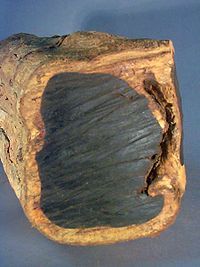
About as densely darkened as wood comes without artificial dying.
From: The Wood Explorer
Common Name(s): Gaboon Ebony, African Ebony, Nigerian Ebony, Cameroon Ebony
Scientific Name: Diospyros crassiflora
Distribution: Equatorial West Africa
Tree Size: 50-60 ft (15-18 m) tall, 2 ft (.6 m) trunk diameter
Average Dried Weight: 65 lbs/ft3 (1,035 kg/m3)
Basic Specific Gravity: .78
Hardness: 3,220 lbf (14,320 N)
Rupture Strength: 24,300 lbf/in2 (167,600 kPa)
Elastic Strength: 2,494,000 lbf/in2 (17,200 MPa)
Crushing Strength: 12,980 lbf/in2 (89.5 MPa)
Shrinkage: Radial: 6.5%, Tangential: 9.0%, Volumetric: 15.5%, T/R Ratio: 1.4
Search This Blog
Showing posts with label African ebony. Show all posts
Sunday, February 5, 2012
Know Your Wood: African Blackwood
African Blackwood
Nothing says "I'm me! Look, dammit!" quite like a gilded African Blackwood ipad.
Common trade names: African Blackwood, African ebony, Ebene, Zebra wood, Mpingo.
Genus: Dalbergia melanoxylon
Janka Hardness (pounds-force): 2940-4730*
Description: Not considered the true ebony, but considered the original African ebony, if that makes any sense. This commercially available wood is grown in Africa natively, and has been farmed successfully in Florida and Asia, if numerous sources are to be trusted. *There is some ambiguity to the specific scientific properties of this species. In any event, there is consensus that this species is extremely dense and hard. In at least one test, it measured the hardest among roughly 285 species.
Location: Central Africa, namely: Angola, Central African Republic, Kenya, Mozambique, Nigeria, Sudan, Tanzania, Uganda, Zimbabwe.
Common Aliases: African ebony, African grenadillo, Blackwood, Ebene, Lurr, Mozambique ebony, Muhati, Murwiti, Pingo, Rugbe, Shami, Umbambangwe.
Performance: Tungsten/Carbide tipped saws should be used in working African Blackwood. Blunting is severe in the machining process, boring and cutting are difficult, so always exercise care with sharp tools. I would tend to believe the upper realm of the hardness scale range for this species.
Acclimation: This species is available mainly in smaller quantities, and is a quite expensive product. Still, allow time for the species to equalize its moisture content to your environment.
In case the ipad didn't quite float your boat, team Jobs, RIP, provides other options.
Common Uses: Modern common applications are turnings and fine woodworks. African Blackwood is coveted by craftsmen globally.
From: The Wood Database
Common Name(s): African Blackwood, Mpingo (Swahili)
Scientific Name: Dalbergia melanoxylon
Distribution: Dry savanna regions of central and southern Africa
Tree Size: 20-30 ft (6-9 m) tall, 2-3 ft (.6-1.0 m) trunk diameter
Average Dried Weight: 82 lbs/ft3 (1,310 kg/m3)
Basic Specific Gravity: 1.08
Hardness: 4,730 lbf (21,060 N)*
*Estimated hardness based on specific gravity (see comments below).
Rupture Strength: 31,000 lbf/in2 (213,790 kPa)
Elastic Strength: 2,980,000 lbf/in2 (20,550 MPa)
Crushing Strength: 10,470 lbf/in2 (72.2 MPa)
Shrinkage: Radial: 2.5%, Tangential: 4.5%, Volumetric: 7.6%, T/R Ratio: 1.8
Nothing says "I'm me! Look, dammit!" quite like a gilded African Blackwood ipad.
Common trade names: African Blackwood, African ebony, Ebene, Zebra wood, Mpingo.
Genus: Dalbergia melanoxylon
Janka Hardness (pounds-force): 2940-4730*
Description: Not considered the true ebony, but considered the original African ebony, if that makes any sense. This commercially available wood is grown in Africa natively, and has been farmed successfully in Florida and Asia, if numerous sources are to be trusted. *There is some ambiguity to the specific scientific properties of this species. In any event, there is consensus that this species is extremely dense and hard. In at least one test, it measured the hardest among roughly 285 species.
Location: Central Africa, namely: Angola, Central African Republic, Kenya, Mozambique, Nigeria, Sudan, Tanzania, Uganda, Zimbabwe.
Common Aliases: African ebony, African grenadillo, Blackwood, Ebene, Lurr, Mozambique ebony, Muhati, Murwiti, Pingo, Rugbe, Shami, Umbambangwe.
Performance: Tungsten/Carbide tipped saws should be used in working African Blackwood. Blunting is severe in the machining process, boring and cutting are difficult, so always exercise care with sharp tools. I would tend to believe the upper realm of the hardness scale range for this species.
Acclimation: This species is available mainly in smaller quantities, and is a quite expensive product. Still, allow time for the species to equalize its moisture content to your environment.
In case the ipad didn't quite float your boat, team Jobs, RIP, provides other options.
Common Uses: Modern common applications are turnings and fine woodworks. African Blackwood is coveted by craftsmen globally.
From: The Wood Database
Common Name(s): African Blackwood, Mpingo (Swahili)
Scientific Name: Dalbergia melanoxylon
Distribution: Dry savanna regions of central and southern Africa
Tree Size: 20-30 ft (6-9 m) tall, 2-3 ft (.6-1.0 m) trunk diameter
Average Dried Weight: 82 lbs/ft3 (1,310 kg/m3)
Basic Specific Gravity: 1.08
Hardness: 4,730 lbf (21,060 N)*
*Estimated hardness based on specific gravity (see comments below).
Rupture Strength: 31,000 lbf/in2 (213,790 kPa)
Elastic Strength: 2,980,000 lbf/in2 (20,550 MPa)
Crushing Strength: 10,470 lbf/in2 (72.2 MPa)
Shrinkage: Radial: 2.5%, Tangential: 4.5%, Volumetric: 7.6%, T/R Ratio: 1.8
Subscribe to:
Posts (Atom)


