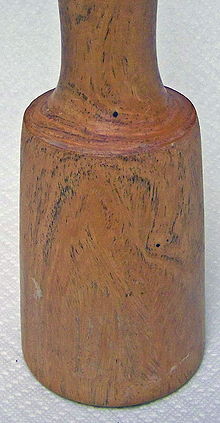
Australian Buloke
The Australian Bull Oak tests out as the most difficult to penetrate by at least one measure.
Common trade names: buloke, bull-oak
Genus: Allocasuarina luehmannii
Janka Hardness (pounds-force): 5060
Description: Possibly there exist limitations to what a woodworker will endure. I’ve been unable to locate any information about the use of this lumber as a lumber, but I’ve found that it’s vital to the continuing survival of a southeastern subspecies of the Austrialian Red-tailed Black Cockatoo for both food and lodging.
Location: Victoria, Queensland, New South Wales in Australia
Common Aliases: Australian buloke, Australian bull-oak
Performance: If you can get your hands on some of this, please let me know how it turns out for you. I believe it would be interesting to hear at least one opinion except that it’s the hardest wood that’s been tested with the Janka scale. There is mention from Australian government issues alluding to its strong performance as a fuel wood. It looks like it should be able to grow about anywhere, and it is unclear whether this wood is useful at all to the professional or hobbyist woodman.
Acclimation: It looks as though one would have to travel to Australia, and possibly purchase this wood on the black market. I have seen no place where it is being sold in the United States, and I don’t know how Australian jails might differ from American ones, should its trade be illegal. Again, your input could be helpful in this identification project.
Common Uses: Nesting and feeding of the Australian Red-tailed Black Cockatoo.
From: florabank
Common Name(s): Allocasuarina luehmanni
Scientific Name: Allocasuarina luehmanni
Distribution: Queensland, Western New South Wales, Northwestern Victoria
Tree Size: 30-60 ft (10-20 m) tall, 2-3 ft (.6-.9 m) trunk diameter
Average Dried Weight: N/A
Basic Specific Gravity: N/A
Hardness: 5,060 lbs.f.
Rupture Strength: N/A
Elastic Strength: N/A
Crushing Strength: N/A
Shrinkage: N/A
Search This Blog
Showing posts with label properties. Show all posts
Tuesday, January 31, 2012
Know Your Wood: Lignum Vitae
Lignum Vitae
Try not go get whacked with this bad boy. It will win the mallet v. bone competition.
Common trade names: Bera, guayacan, guaiacum, pockenholz (European),
Genus: Guaiacum officinale
Janka Hardness (pounds-force): 4500
Description: Deep olive-brown to brown, sometimes approaching black. Has a uniquely layered grain pattern when held under close inspection. There are trade substitutes available to genuine Lignum Vitae, but the Argentine Lignum Vitae (Verawood) is generally lighter color than that of the wood specified herein.
Location: Caribbean and Central and South America, namely: Bahamas, Costa Rica, Cuba, Hispanola, Nicaragua, Guatemala, Venezuela, Puerto Rico. Farming operations are underway worldwide to ensure continued production of this valued species, though it is currently a highly endangered species.
Common Aliases: Bois de gayac, Bois sant, Legno benedetto, Legno nefritico, Legno santo, Wood of life
Performance: Please take very light passes when working Lignum Vitae. It’s about as hard and as durable as can be obtained against the plagues of rot and insect.
Acclimation: If you’re purchasing Lignum Vitae, you already know this, but for air drying, simply allow a half-inch or so among parallel planks stacked and spaced by level. It’s that easy, and in two or so weeks’ time, the lumber is ready for working in your climate!
Common Uses: Tools, bearings and bushings, pulleys, turnings, countless other turnings and various works requiring the most durable of woods.
From: The Wood Database
Common Name(s): Lignum Vitae
Scientific Name: Guaiacum officinale, G. sanctum
Distribution: Central America and northern South America
Tree Size: 20-30 ft (6-10 m) tall, 1-2 ft (.3-.6 m) trunk diameter
Average Dried Weight: 84 lbs/ft3 (1,350 kg/m3)
Basic Specific Gravity: 1.02
Hardness: 4,500 lbf (20,020 N)
Rupture Strength: 17,760 lbf/in2 (122,490 kPa)
Elastic Strength: 2,304,000 lbf/in2 (15,890 MPa)
Crushing Strength: 11,400 lbf/in2 (78.6 MPa)
Shrinkage: Radial: 5.0%, Tangential: 8.0%, Volumetric: 13.0%, T/R Ratio: 1.6
Try not go get whacked with this bad boy. It will win the mallet v. bone competition.
Common trade names: Bera, guayacan, guaiacum, pockenholz (European),
Genus: Guaiacum officinale
Janka Hardness (pounds-force): 4500
Description: Deep olive-brown to brown, sometimes approaching black. Has a uniquely layered grain pattern when held under close inspection. There are trade substitutes available to genuine Lignum Vitae, but the Argentine Lignum Vitae (Verawood) is generally lighter color than that of the wood specified herein.
Location: Caribbean and Central and South America, namely: Bahamas, Costa Rica, Cuba, Hispanola, Nicaragua, Guatemala, Venezuela, Puerto Rico. Farming operations are underway worldwide to ensure continued production of this valued species, though it is currently a highly endangered species.
Common Aliases: Bois de gayac, Bois sant, Legno benedetto, Legno nefritico, Legno santo, Wood of life
Performance: Please take very light passes when working Lignum Vitae. It’s about as hard and as durable as can be obtained against the plagues of rot and insect.
Acclimation: If you’re purchasing Lignum Vitae, you already know this, but for air drying, simply allow a half-inch or so among parallel planks stacked and spaced by level. It’s that easy, and in two or so weeks’ time, the lumber is ready for working in your climate!
Common Uses: Tools, bearings and bushings, pulleys, turnings, countless other turnings and various works requiring the most durable of woods.
From: The Wood Database
Common Name(s): Lignum Vitae
Scientific Name: Guaiacum officinale, G. sanctum
Distribution: Central America and northern South America
Tree Size: 20-30 ft (6-10 m) tall, 1-2 ft (.3-.6 m) trunk diameter
Average Dried Weight: 84 lbs/ft3 (1,350 kg/m3)
Basic Specific Gravity: 1.02
Hardness: 4,500 lbf (20,020 N)
Rupture Strength: 17,760 lbf/in2 (122,490 kPa)
Elastic Strength: 2,304,000 lbf/in2 (15,890 MPa)
Crushing Strength: 11,400 lbf/in2 (78.6 MPa)
Shrinkage: Radial: 5.0%, Tangential: 8.0%, Volumetric: 13.0%, T/R Ratio: 1.6
Saturday, January 28, 2012
Know Your Wood: Massaranduba
Massaranduba
Time on this rock is precious. We call it Massa.
Common trade names: Massaranduba, Massa, Brazilian Redwood
Genus: Malinkara bidentata
Janka Hardness (pounds-force): 3190
Description: Massaranduba is a cost-effective, yet highly comparable alternative to slightly denser and more costly selections such as Ipe and Cumaru. Deep red hues accompany this delightful tropical hardwood, and the effective life of this species is over a couple of decades. The heartwood presentation may resemble that of purpleheart, though this is a different species. Straighter grains than most of the tropical hardwoods we offer, and the tree itself yields a natural latex (balata) from the sap, in addition to an edible fruit.
Location: Central and South America, Caribbean.
Common Aliases: Bullet wood, Balata, Bolivian Cherry, Ausubo, Macaranduba
Performance: Highly comparable to tropical hardwoods Ipe and Cumaru, but slightly easier to work.
Acclimation: As with any tropical hardwood, allow your material to adjust properly to its new environment fully stacked, spaced, and covered for a minimum of ten days. You will be glad you waited.
Common Uses: Golf balls (hist.), exterior decking, shiplap, rainscreen siding, whip handles, furnishings, patio furniture.
Properties from: The Wood Database
Bulletwood (Manilkara bidentata)
Common Name(s): Bulletwood, Massaranduba
Scientific Name: Manilkara bidentata
Distribution: Carribean, Central and South America
Tree Size: 100-150 ft (30-46 m) tall, 2-4 ft (.6-1.2 m) trunk diameter
Average Dried Weight: 66 lbs/ft3 (1,060 kg/m3)
Basic Specific Gravity: .85
Hardness: 3,190 lbf (14,190 N)
Rupture Strength: 29,690 lbf/in2 (204,760 kPa)
Elastic Strength: 3,332,000 lbf/in2 (22,980 MPa)
Crushing Strength: 13,380 lbf/in2 (92.3 MPa)
Shrinkage: Radial: 6.3%, Tangential: 9.4%, Volumetric: 16.9%, T/R Ratio: 1.5
Time on this rock is precious. We call it Massa.
Common trade names: Massaranduba, Massa, Brazilian Redwood
Genus: Malinkara bidentata
Janka Hardness (pounds-force): 3190
Description: Massaranduba is a cost-effective, yet highly comparable alternative to slightly denser and more costly selections such as Ipe and Cumaru. Deep red hues accompany this delightful tropical hardwood, and the effective life of this species is over a couple of decades. The heartwood presentation may resemble that of purpleheart, though this is a different species. Straighter grains than most of the tropical hardwoods we offer, and the tree itself yields a natural latex (balata) from the sap, in addition to an edible fruit.
Location: Central and South America, Caribbean.
Common Aliases: Bullet wood, Balata, Bolivian Cherry, Ausubo, Macaranduba
Performance: Highly comparable to tropical hardwoods Ipe and Cumaru, but slightly easier to work.
Acclimation: As with any tropical hardwood, allow your material to adjust properly to its new environment fully stacked, spaced, and covered for a minimum of ten days. You will be glad you waited.
Common Uses: Golf balls (hist.), exterior decking, shiplap, rainscreen siding, whip handles, furnishings, patio furniture.
Properties from: The Wood Database
Bulletwood (Manilkara bidentata)
Common Name(s): Bulletwood, Massaranduba
Scientific Name: Manilkara bidentata
Distribution: Carribean, Central and South America
Tree Size: 100-150 ft (30-46 m) tall, 2-4 ft (.6-1.2 m) trunk diameter
Average Dried Weight: 66 lbs/ft3 (1,060 kg/m3)
Basic Specific Gravity: .85
Hardness: 3,190 lbf (14,190 N)
Rupture Strength: 29,690 lbf/in2 (204,760 kPa)
Elastic Strength: 3,332,000 lbf/in2 (22,980 MPa)
Crushing Strength: 13,380 lbf/in2 (92.3 MPa)
Shrinkage: Radial: 6.3%, Tangential: 9.4%, Volumetric: 16.9%, T/R Ratio: 1.5
Friday, January 27, 2012
Know Your Wood: Garapa
Garapa
Blonde and beautiful. The fun might last a while longer with the wood, though.
Common trade names: Brazilian Ash, Amarealao, Marotoa, Muiratua, Grapia.
Genus: Apuleia leiocarpa
Janka Hardness (pounds-force): 1650
Description: The lumber is derived from the genus of flowering legumes family, Fabaceae. Generally golden to fair brown in color, and its perceived hue can be quite affected by the effects of direct and indirect light. Interesting wood. Quite unique, however, and is much easier to work than Ipe or Cumaru.
Location: South America
Common Aliases: Brazilian Ash, grapia, Garrote, Muirajuba, Brazilian Oak. Garapa appears to have an identity crisis!
Performance: While easy to work, Garapa is a more or less generically scented wood that is fairly durable. Do not let anyone tell you Garapa is impervious to insects, because it isn’t. Nevertheless, it is a well above-average performing wood.
Acclimation: Garapa for an outdoor application should be kept on site, stacked and covered for one to three weeks prior to installation. Local climactic variations require a longer window.
Common Uses: Decks and docks, boats, exterior siding, and many other applications. We recommend to avoid direct ground contact with Garapa. Kiln dried Garapa will produce a sharp interior flooring, but remember that acclimation also applies to indoor installation projects!
From: The Wood Database
Garapa (Apuleia leiocarpa)
Common Name(s): Garapa
Scientific Name: Apuleia leiocarpa
Distribution: South America
Tree Size: 65-100 ft (20-30 m) tall, 3-5 ft (1-1.5 m) trunk diameter
Average Dried Weight: 52 lbs/ft3 (835 kg/m3)
Basic Specific Gravity: .66
Hardness: 1,650 lbf (7,320 N)
Rupture Strength: 17,020 lbf/in2 (117,340 kPa)
Elastic Strength: 2,163,000 lbf/in2 (14,920 MPa)
Crushing Strength: 9,140 lbf/in2 (63.0 MPa)
Shrinkage: Radial: 4.2%, Tangential: 7.5%, Volumetric: 11.7%, T/R Ratio: 1.8
Blonde and beautiful. The fun might last a while longer with the wood, though.
Common trade names: Brazilian Ash, Amarealao, Marotoa, Muiratua, Grapia.
Genus: Apuleia leiocarpa
Janka Hardness (pounds-force): 1650
Description: The lumber is derived from the genus of flowering legumes family, Fabaceae. Generally golden to fair brown in color, and its perceived hue can be quite affected by the effects of direct and indirect light. Interesting wood. Quite unique, however, and is much easier to work than Ipe or Cumaru.
Location: South America
Common Aliases: Brazilian Ash, grapia, Garrote, Muirajuba, Brazilian Oak. Garapa appears to have an identity crisis!
Performance: While easy to work, Garapa is a more or less generically scented wood that is fairly durable. Do not let anyone tell you Garapa is impervious to insects, because it isn’t. Nevertheless, it is a well above-average performing wood.
Acclimation: Garapa for an outdoor application should be kept on site, stacked and covered for one to three weeks prior to installation. Local climactic variations require a longer window.
Common Uses: Decks and docks, boats, exterior siding, and many other applications. We recommend to avoid direct ground contact with Garapa. Kiln dried Garapa will produce a sharp interior flooring, but remember that acclimation also applies to indoor installation projects!
From: The Wood Database
Garapa (Apuleia leiocarpa)
Common Name(s): Garapa
Scientific Name: Apuleia leiocarpa
Distribution: South America
Tree Size: 65-100 ft (20-30 m) tall, 3-5 ft (1-1.5 m) trunk diameter
Average Dried Weight: 52 lbs/ft3 (835 kg/m3)
Basic Specific Gravity: .66
Hardness: 1,650 lbf (7,320 N)
Rupture Strength: 17,020 lbf/in2 (117,340 kPa)
Elastic Strength: 2,163,000 lbf/in2 (14,920 MPa)
Crushing Strength: 9,140 lbf/in2 (63.0 MPa)
Shrinkage: Radial: 4.2%, Tangential: 7.5%, Volumetric: 11.7%, T/R Ratio: 1.8
Subscribe to:
Posts (Atom)